Warm Up and Launch
The algorithm does not know what your page is on day one. Warm-up is the process of teaching it — before your clips are exposed to any audience.
Why posting cold almost always underperforms
When you create a fresh account and post your first clip immediately, the algorithm has no prior signal to work from. It does not know your niche, your audience, or who is likely to engage with your content. So it pushes the clip to a broadly random test batch — a mix of users that may or may not include people interested in your category.
If that random test batch engages poorly — because most of them have no interest in the niche — the algorithm interprets low engagement as "this clip is not worth pushing further." The clip stalls. It is not that the clip was bad. It is that it reached the wrong people first because the account had no context.
Warm-up is the process of giving the algorithm context before you post. When the account has established behavioral signals — the types of content it watches, the pages it interacts with, the searches it runs — the algorithm has a working hypothesis about the account's category. Your first clip lands in a more relevant test batch, which means better initial engagement, which means broader distribution.
The practical difference: a warm account posting its first clip in the right niche test batch might see 2,000–5,000 views before the algorithm decides whether to push further. A cold account with the same clip might see 200–400 views from a random batch that barely engages. The clip is identical — the context is not.

What actually creates algorithmic signal during warm-up
Not all activity builds useful signal. Understanding what the algorithm actually weights helps you warm up efficiently instead of just scrolling randomly for three days and calling it done.
A structured warm-up schedule that actually works
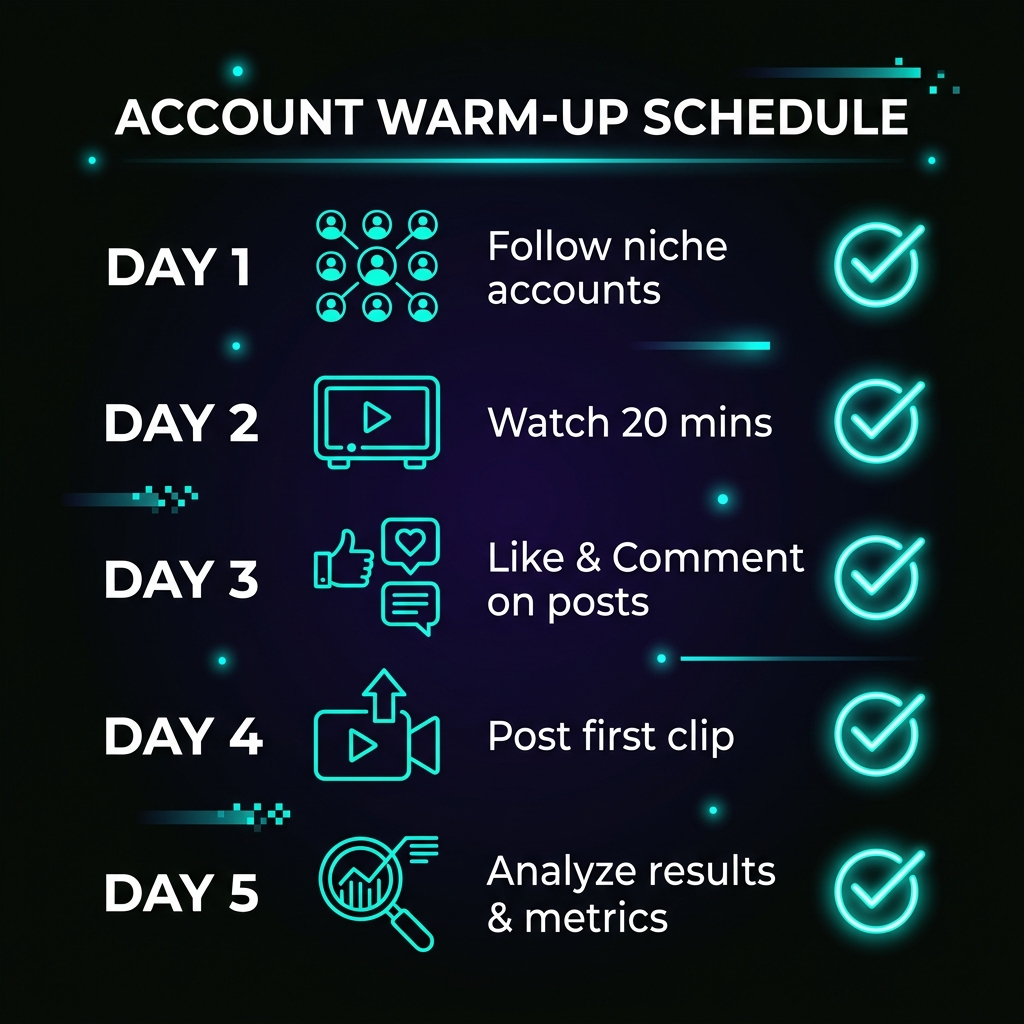
Warm-up does not need to take weeks. Two to four focused days is sufficient on most platforms. The key is that the time must be deliberate — not passive scrolling. Here is a schedule that builds the signal efficiently:
Feed initialization
- Search your top 5 niche keywords directly
- Watch the top 10 results for each keyword fully
- Follow the 5–10 strongest pages you find
- Save your 3–5 favourite clips from today
- Scroll past anything unrelated without engaging
Deep niche immersion
- Check if your For You feed has shifted toward your niche
- Watch 30–40 minutes of niche content — especially newer posts
- Identify your top 3 source creators to clip from
- Study what types of clips are performing best this week
- Note caption patterns used by top pages
Research and preparation
- Audit whether the For You feed is now predominantly your niche
- Select and download your first 5–7 source clips
- Produce your first 3 clips ready to post
- Set up your cover image template if applicable
- Draft your first 5 captions following niche patterns
Launch day
- Post your first clip — best quality you have prepared
- Watch its performance in the first 2 hours
- Post a second clip if the first shows any positive signal
- Continue warm-up behavior (watching, engaging in niche)
- Do not delete or alter early posts — let data accumulate
The research mindset — warm-up as competitive intelligence
One of the most underused aspects of warm-up is that it gives you free, uninterrupted time to study your competition. Once you start posting, you are in production mode — always focused on what to post next. During warm-up, your only job is to observe and learn.
What to document during the research phase
How to know the warm-up worked
The simplest test is your For You feed. Open the app, scroll through 30 posts without searching anything. If more than 80% of what you see is your target niche, the account has been successfully trained. If you are still seeing random unrelated content, the warm-up is incomplete.
Ready to post
- Feed is 80%+ niche-specific
- You have identified 3+ source creators
- You have 3–5 clips prepared and ready
- You have studied caption style in the niche
- You know what the first frame of a good clip looks like
Keep warming up
- Feed still shows random unrelated content
- You have not identified good source creators
- You do not know what high-performing clips look like in this niche
- You are unsure what captions or hooks work here
- You have fewer than 3 clips prepared
Launch strategy — the first week matters more than any other
The algorithm forms its model of your account primarily from early behavior. The first week of posting is when the platform is most actively updating its understanding of your page. This is the week where consistency, niche coherence, and clip quality compound fastest.
First week launch rules
- Post every day. Not because frequency directly boosts reach, but because daily posting keeps the algorithmic update cycle active. Gaps in the first week let the model go stale.
- Never post outside your niche in the first month. Every off-niche post is a signal that weakens your category assignment. The first 30 days are category-building time.
- Do not delete underperforming clips. Every post — even a bad one — adds data. Deleting posts removes that data and creates gaps in the posting history that look like inactivity.
- Respond to early comments. Comment engagement in the first 30–60 minutes after posting is heavily weighted. A clip that sparks a conversation gets pushed further than a clip that gets quiet views.
- Analyze each clip 24 hours after posting. Look at watch time and completion rate specifically. These tell you whether the clips are hitting — not the view count, which can be misleading on a new account.
On patience: most accounts do not hit their stride in the first week. The algorithm is still building its model. Accounts that are consistent through weeks 2 and 3 — even if week 1 looks quiet — typically see significantly better distribution once the model matures. Abandoning an account in week 1 because numbers look low is one of the most common and costly mistakes in clipping.
Warm-up and launch mistakes that waste weeks of work
Once the account is live and posting, the question becomes: what makes some clips perform and others stall? Chapter 5 breaks down the mechanics of retention, hook construction, and the feedback loop that separates pages that grow from those that plateau.