Pick Your Niche
Most people pick randomly and wonder why the account never gains traction. Niche selection is a decision with a data-driven answer — here is how to find it.
Why niche is not a branding choice — it is an algorithmic one
Most beginners think of niche as a "content theme" — a loose direction like "gaming" or "sports." That framing misses what niche actually does inside a recommendation algorithm.
Every interaction a viewer has with your content — watching, scrolling past, sharing, commenting — feeds a signal back to the platform about what kind of account you are. Over time, the platform builds a model of your page and uses that model to decide who to push your future content to. A coherent niche makes that model accurate. A scattered niche makes it noisy and unreliable.
Concretely: if your page posts a gaming clip, a music clip, a political clip, and a sports clip in the same week, the platform cannot confidently assign your account to any audience segment. When you post your next video, it does not know which test batch to push it to first. Your initial audience pool is random, which means your completion and engagement rates on the first push are lower, which means the clip reaches fewer people overall.
The compounding effect: a niche-coherent page with 10,000 followers that posts consistently in one category will often outperform a scattered page with 100,000 followers. The algorithm pushes content to people who have already shown they like it. That signal only builds if the content is consistent.
The four variables that determine whether a niche is worth building in
Not all niches have equal upside. Before committing to one, evaluate it across four dimensions:
Content volume
How much fresh source material is produced every week? A niche that generates 50+ hours of clippable content per week gives you far more options than one that produces a handful of videos. High volume reduces the pressure to make every clip work — you can afford to post frequently and iterate.
Moment density
Not all content produces clippable moments at the same rate. A 3-hour gaming stream might have 4 genuinely strong moments. A 2-hour interview podcast might have 12. Moment density — how many strong clips you can extract per hour of source material — determines your output efficiency.
Audience CPM geography
Some niches naturally attract audiences from high-CPM regions (US, UK, Canada, Australia, Western Europe). Others attract audiences that are geographically diverse in ways that lower the average qualification rate. A niche with passionate audiences in high-CPM regions is worth more per view than one with equal engagement from lower-CPM regions.
Campaign availability
Are there campaigns you can actually join in this niche? Some niches have abundant campaign options — iGaming and crypto adjacent content, for example, have well-funded campaign programs. Others are almost entirely campaign-free, meaning monetization depends on platform rev share or brand deals rather than performance clipping payouts.

How niches compare on actual profitability
These are honest characterizations of the most common clipping niches across the four variables. No niche is perfect — every one involves tradeoffs.
iGaming / crypto adjacent
Best CPM in the ecosystem by far. Campaign volume is strong. The tradeoff is that platform policy is more aggressive toward this type of content — account restrictions are more common, and you need to understand what compliance looks like. Best suited for clippers willing to learn the policy landscape carefully.
Streaming and gaming
Enormous content supply and active campaign ecosystem. CPMs are lower than iGaming but page restrictions are less common. Strong for beginners building their first accounts because the content is abundant and easy to find. Competitive but also the most established ecosystem for clippers.
Music and hip-hop
Excellent moment density — music content produces a lot of clippable moments per hour. Content resonates strongly on short-form platforms. Campaign availability is more variable than gaming. Copyright is a genuine risk in this niche and requires careful source selection. Best for clippers who are genuinely embedded in music culture.
Podcast and talking-head
Strong for pages that can build real audience loyalty. Clip content tends to retain longer because the ideas are substantive. CPMs can be good when audience is well-targeted. Weak on campaign availability — most podcasters do not run structured clipping programs. Better suited for organic clippers building toward brand deals than campaign clippers chasing CPMs.
Trending news and sports
Extremely high content velocity — potentially the most competitive niche. Views can spike dramatically on breaking stories but burn out fast. CPMs tend to be lower and campaign availability is poor. The business case depends on volume and platform rev share rather than CPM campaigns. High risk, high variance.
Going deeper: why sub-niches outperform broad categories
Picking "gaming" as a niche puts you in direct competition with thousands of pages. Picking "speedrunning highlights" puts you in competition with dozens. The audience for the sub-niche is smaller but the signal is much cleaner, the content expectations are more defined, and the algorithm can place your page more precisely.
Sub-niches also create a compounding advantage: as your page becomes the go-to source for a specific category of content, followers recommend it to others in that interest cluster. That kind of organic growth is almost impossible to achieve in a broad niche where you are one of hundreds of similar pages.
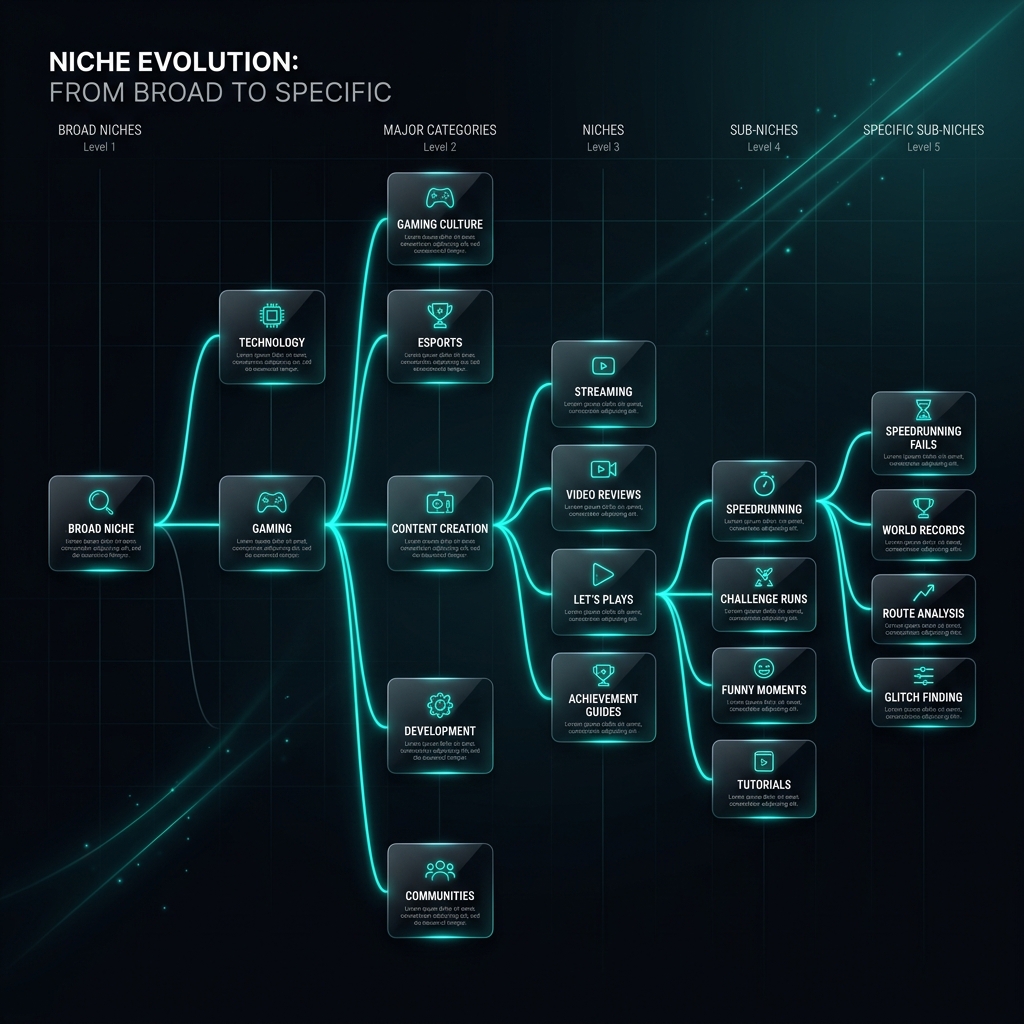
Broad niche (hard mode)
- "Gaming" — competing with thousands of pages
- "Music" — no clear identity signal
- "Streaming" — algorithm cannot place you
- "Sports" — every sports moment already has a page
Sub-niche (focused mode)
- "Speedrunning fails and world records"
- "Underground rap battles and freestyles"
- "IRL streamer chaos moments"
- "F1 team radio and onboards"
How to test whether a niche is saturated or just popular
Saturation and popularity are different. A popular niche has a lot of pages but also a lot of demand. A saturated niche has more pages than the audience can support, which means most pages grow slowly regardless of quality. Knowing the difference prevents you from entering a war you cannot win, or avoiding a niche that just looks crowded because demand is high.
The saturation check — run this before committing
- Search the niche on TikTok. How many pages with over 50K followers exist? If there are 500+ established pages, that is a signal of saturation, not just popularity.
- Look at newer pages in the niche. Find accounts that started in the last 6 months. Are any of them growing past 10K followers? If newer pages cannot break through, the niche may be saturated.
- Check total view counts on recent posts. Is there still a healthy floor of views even for smaller pages, or is all the traffic concentrated at the top? Concentration is a saturation signal.
- Look at the sub-niche level. Even if the broad niche is saturated, sub-niches within it may be wide open. The saturation problem is almost always at the broad level, not the specific level.
Content cycles: does your niche have predictable supply?
Some niches produce content in unpredictable bursts — a news event happens, clips spike for a week, then dry up. Others have a steady, predictable rhythm — a streamer goes live daily, podcasts drop weekly, sports seasons produce regular match content.
Predictable content cycles are operationally superior. You can plan your posting schedule, maintain consistent output, and build the kind of posting rhythm that algorithms reward. Event-driven niches require you to spike and recover, which creates inconsistency in your posting pattern even if you are working hard.
Steady-cycle niches
Content produced on a reliable schedule — daily, weekly, or tied to ongoing activity.
- Daily live streamers
- Weekly podcast releases
- Active Discord communities
- Sports leagues in-season
Event-driven niches
Content spikes around events — requires constant monitoring and fast response.
- Breaking news and viral drama
- Album and single releases
- Major sports tournaments
- Influencer controversies

The 10-clip test — validate before you commit fully
Before investing weeks into a niche, run a quick validation. Create a page, warm it up briefly (two to three days), and post 10 clips that represent what you think strong content in the niche looks like. Do not tweak the niche mid-test — post 10 clips in the same lane and observe.
What to look for after 10 clips
If 3 or 4 of these signals appear after 10 clips, the niche is worth committing to. If fewer than 2 appear, the problem is either the niche (poor fit) or the execution (clips are weak) — and it is worth diagnosing which before abandoning the niche entirely.
How to properly research a niche before building in it
Research is not scrolling through your For You page. It is a structured analysis of the niche you are considering. Spend 2–4 hours on this before creating a single account.
- Find the top 5–10 pages in the niche. Study their bio, username, profile picture, posting frequency, caption style, and which clips get the most views. These pages are your benchmarks.
- Identify the 3–5 source creators you will clip from. Are they active? How often do they post? Is there a permission or campaign model in place, or would you be clipping independently?
- Analyze the best-performing clips. What is the average length? What type of moment performs best — funny, dramatic, informational, chaotic? What do the captions look like?
- Search for campaign availability. Look in clip marketplaces and Discord servers for active campaigns in this niche. What CPMs are on offer?
- Assess your personal interest level. Could you watch 20 hours of this type of content per week for 3 months without burning out? If the answer is no, the niche will grind you down.
Niche mistakes that compound badly over time
With a validated niche in hand, the next step is building pages that look like they belong in that lane. A weak setup undermines strong clips — Chapter 3 covers every element of page construction that actually matters.