How Clips Turn Into Cash
Views are attention. Revenue requires that attention to sit inside the right payout structure — and knowing how to judge that structure before you join.
The gap most clippers never close
Most beginners understand the basic premise: post clips, get views, earn money. What they do not understand — until they receive their first payout and it is far lower than expected — is that the path from raw views to actual earnings involves multiple filters, each of which can significantly reduce what you get paid.
The clippers who earn consistently are the ones who understand these filters in advance, choose campaigns that work in their favor, and build pages that clear as many of the qualification requirements as possible. Clippers who do not understand this keep posting large view counts while wondering why their payouts are small.

The three payout models — how each one works
Different campaigns pay in fundamentally different ways. Understanding each model before joining prevents surprises, helps you evaluate which campaigns make sense for your pages, and tells you what level of performance you need to make the effort worthwhile.
CPM (Cost Per Mille)
You earn a fixed rate per 1,000 qualified views. The campaign sets the CPM rate upfront — for example, $7 per 1,000 qualified views. Your earnings scale directly with how many qualified views your clips generate.
- Predictable math — you know exactly what each 1,000 qualified views earns
- Works well at any scale
- Good for clippers with strong, consistent page quality
- Earning potential capped by view volume
- Low CPMs require high volume to produce meaningful income
- Qualification filters reduce raw view count significantly
Revenue share
Instead of a fixed CPM, you earn a percentage of the value the brand generates from the traffic you drove. Common in iGaming and affiliate programs — if someone you referred signs up and deposits money, you earn a cut of that value.
- Upside is uncapped — one high-value referral can pay far more than CPM for the same clip
- Aligns incentives with the brand — better targeting means higher earnings
- Unpredictable — earnings depend on downstream actions you cannot control
- Long attribution windows mean payments arrive weeks after posting
- Harder to evaluate whether effort is paying off in real time
Flat rate / milestone
A fixed payment for delivering a specific output — for example, $500 for 10 clips that together hit 500,000 views, or $200 per clip posted regardless of views. Common in direct creator agreements.
- Guaranteed payment regardless of algorithmic performance
- Simpler to budget and track
- Good for clippers with strong execution but less established pages
- Does not scale with virality — your upside is capped at the flat rate
- Per-clip rates often undervalue strong performers
Qualified views — every filter explained
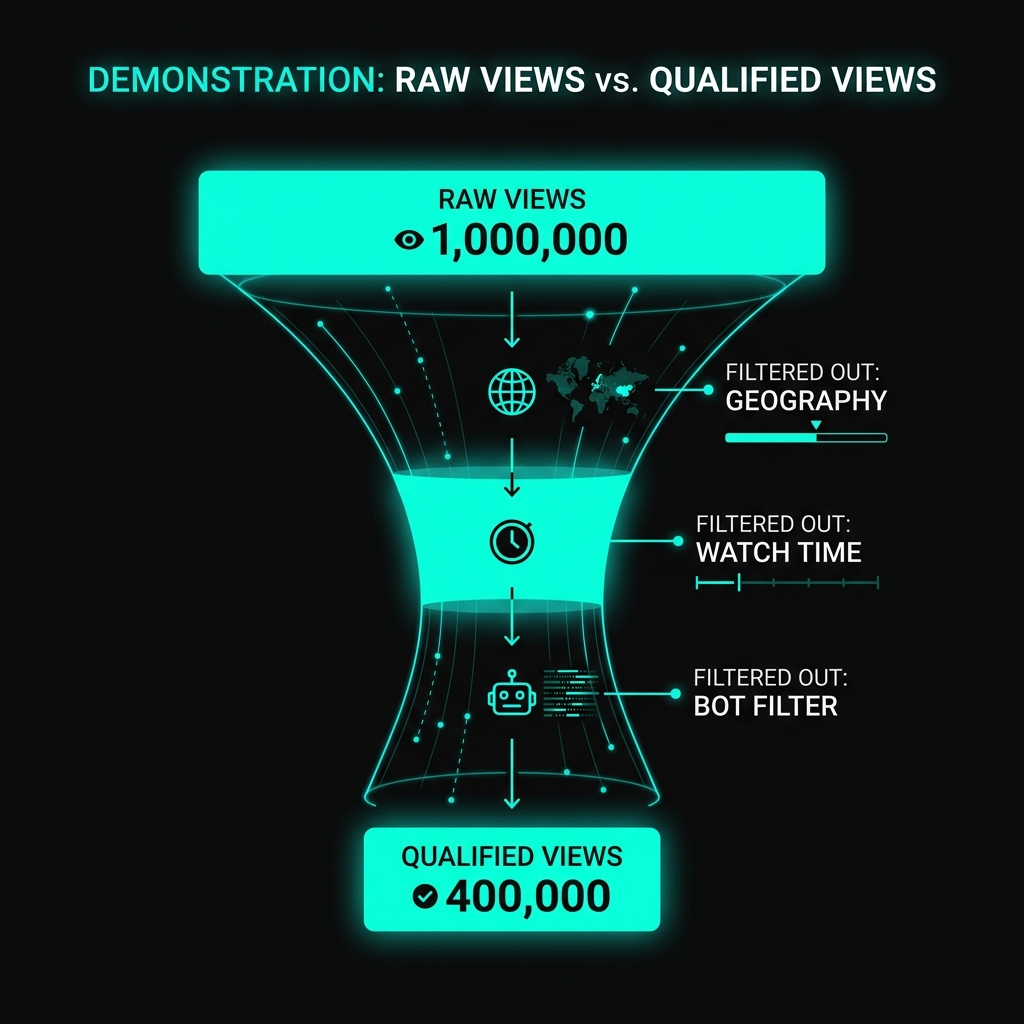
"Qualified views" is the number the campaign actually pays on. It starts from your raw view count and passes through a series of filters. Each filter can reduce the number significantly. Here is what each filter does and how to improve your performance at each one.
Geographic weight
Views from different countries count for different amounts. A view from the US, UK, Canada, or Australia typically qualifies at full rate. A view from a lower-CPM region may qualify at 30–50% of the standard rate, or may not qualify at all.
Watch time threshold
Many campaigns only count views where the viewer watched past a certain completion percentage — often 50% or more of the clip. A view where someone watched 3 seconds of a 60-second clip is not a qualified view.
Anti-bot and fraud filter
Campaign platforms run automated systems to detect artificial or low-quality traffic — bot views, loop farming, or coordinated artificial engagement. Views flagged by these systems are removed.
Campaign compliance
If your clip violates the campaign brief — wrong content, wrong format, wrong platform, wrong account — views from that clip may be disqualified entirely, or your account may be removed from the campaign.
Worked example — what actually gets paid
Geography and your earnings — the lever most clippers ignore
Geographic distribution of your audience is one of the most significant variables in your actual earnings, and it is almost never discussed by beginners because it is invisible — you do not see the breakdown until you look at your analytics.
Two clippers can post the same clip, both receive 100,000 views, and earn dramatically different amounts purely because one page's audience is primarily based in high-CPM regions and the other's is not. The content, the campaign, and the CPM rate are all identical — the geographic composition of the audience is the variable.
What affects audience geography on your page
The campaign vetting framework — before you commit pages
The ability to evaluate a campaign before joining it is a skill that separates productive clippers from ones who waste months on poorly structured programs. Every campaign you join costs time and uses your pages — you want to be confident the exchange is worth it.
Run through this before joining any campaign
Thinking about earnings realistically
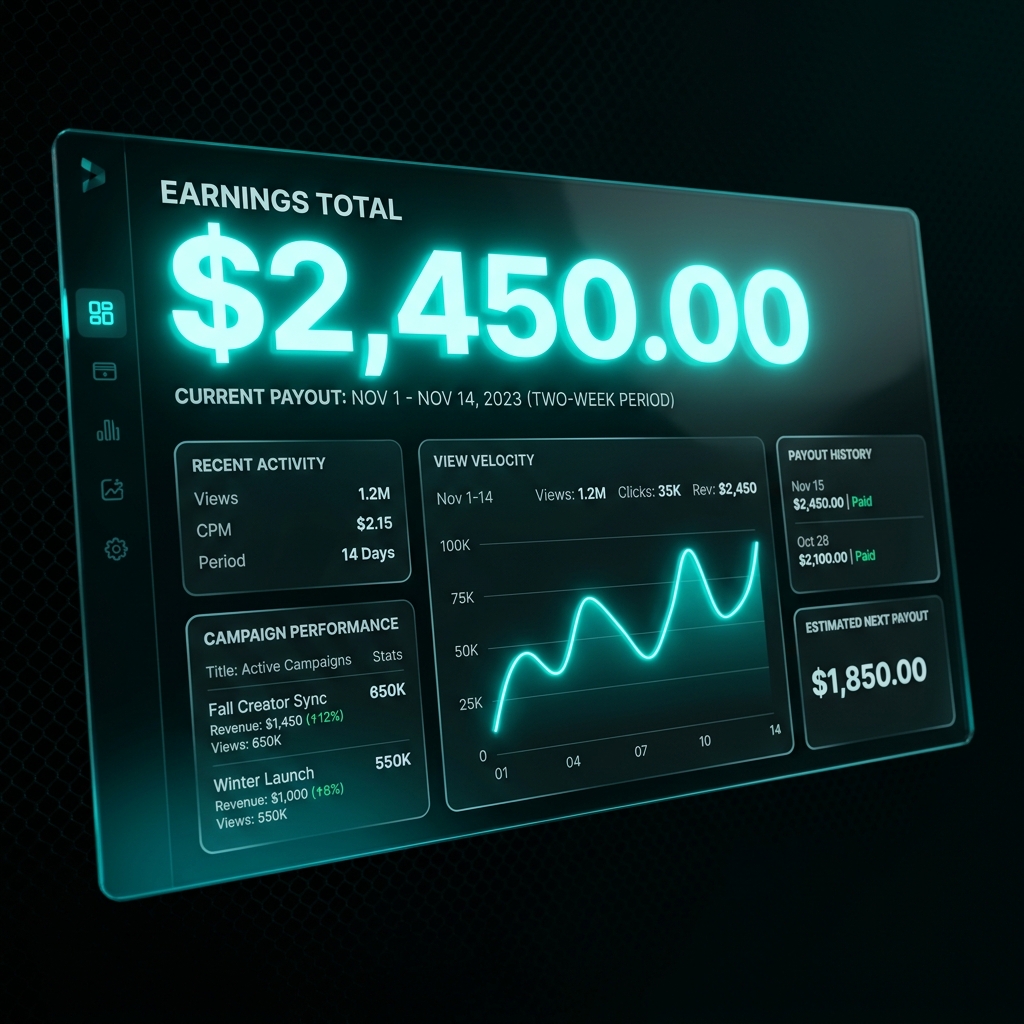
Community screenshots tend to show the best results of the best weeks from the most successful operators. They are real, but they are not representative. Understanding what generates those results matters more than the results themselves.
The variables behind the screenshot
The fastest path to realistic earnings is treating clipping as an iterative learning system rather than a get-paid-immediately mechanism. Each campaign teaches you something about qualification rates, page quality, and content performance. That knowledge compounds — and the clippers who learn fastest earn most consistently.
Monetization mistakes that are easy to avoid once you understand them
Once you have a workflow that produces clips, views, and clean campaign execution, the question becomes: how do you expand without the system falling apart? Chapter 7 covers operations, team structure, and the discipline required to scale.